
Multi-Surface Composite Codes D2392, D2393, and D2394: A Dental Billing Guide
Composite restorations are among the highest-volume procedures in general dentistry, and in dental billing the surface-count codes are where many of those claims get downcoded or denied. CDT codes D2392, D2393, and D2394 all describe the same procedure, a resin-based composite restoration on a posterior tooth, and the only thing separating these posterior composite codes is the number of surfaces restored. Get the count wrong or document it loosely, and the carrier will make that call for you, usually toward the lower-paying code.
What is D2392?
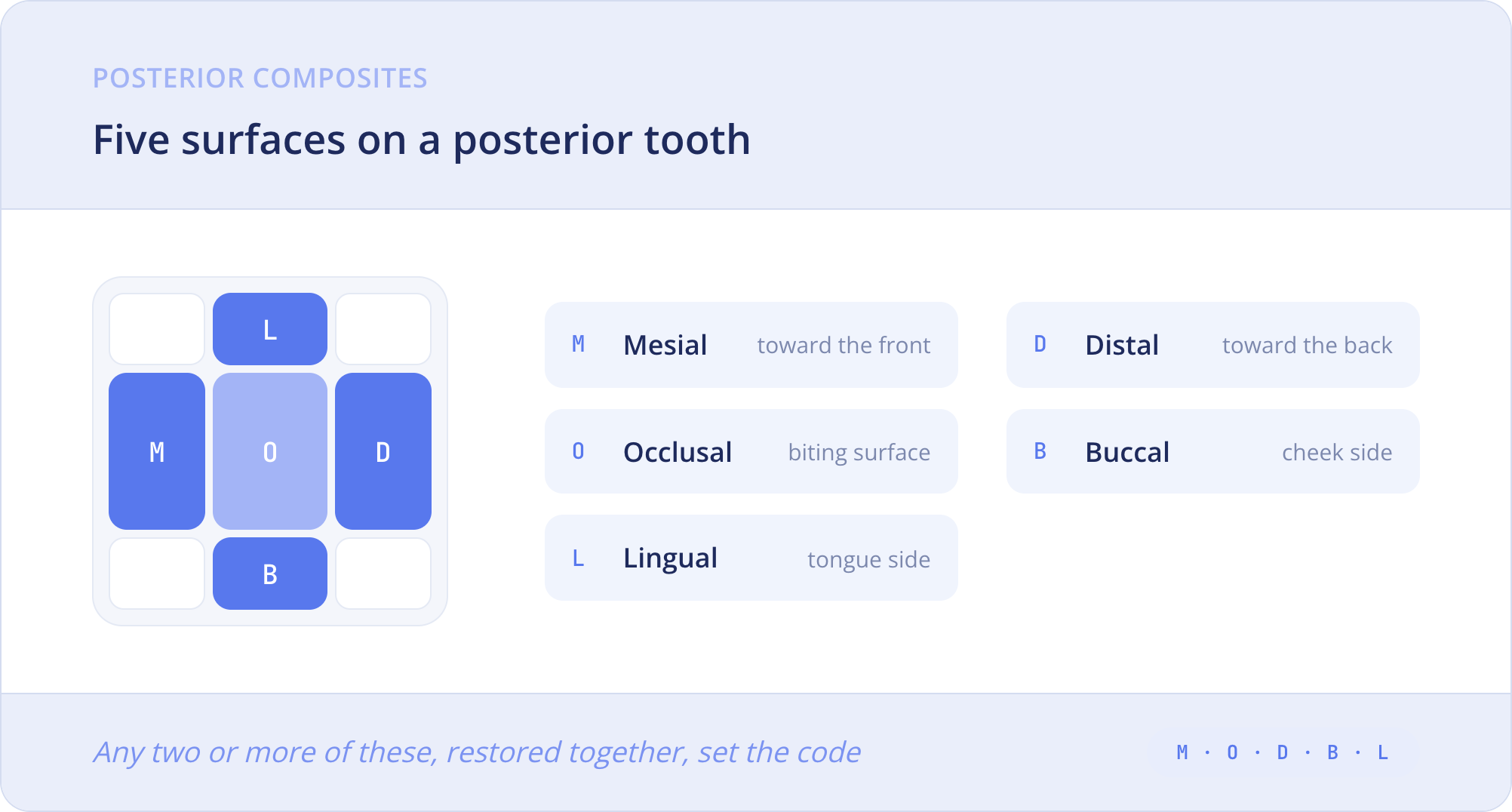
D2392 is the CDT code for a resin-based composite restoration on two surfaces of a posterior tooth. Posterior teeth have five surfaces (mesial, distal, occlusal, buccal, and lingual), and the most common two-surface pairings are mesial-occlusal (MO) and disto-occlusal (DO), though any two-surface combination qualifies.
A claim supports D2392 when:
- Two distinct surfaces are involved, such as mesial and occlusal, or occlusal and buccal.
- The surfaces are contiguous and meet at a shared line angle, rather than two separate areas of decay prepped independently.
- The claim and the chart name the specific surfaces, as in "MO composite, tooth #3," instead of a general "two-surface filling."
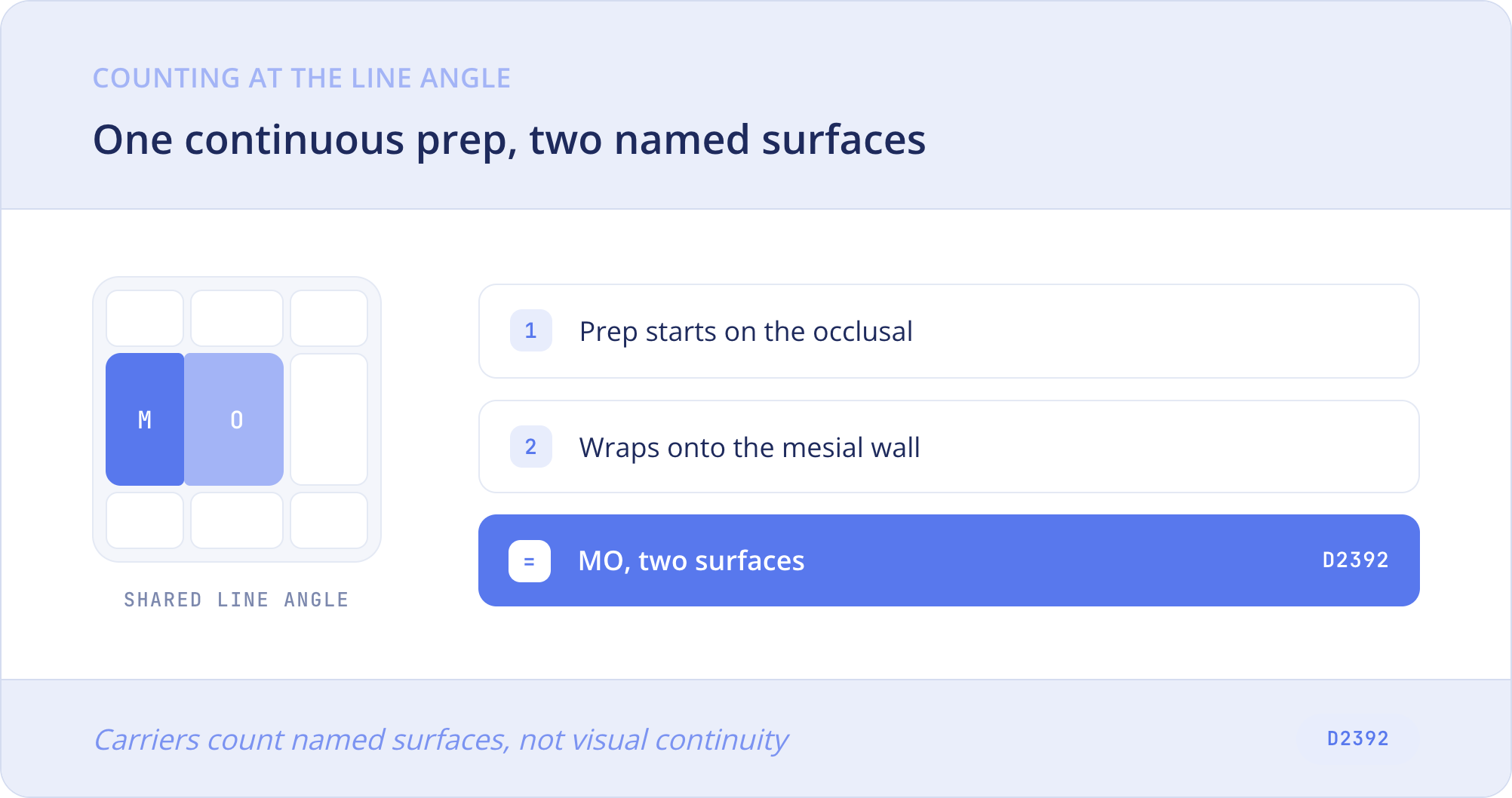
The most common slip with this code is miscounting at a line angle. A prep that starts on the occlusal and wraps onto the mesial wall is a two-surface restoration, MO, even when it looks like one continuous prep, because carriers count named surfaces rather than visual continuity.
What is D2393?
D2393 covers a resin-based composite restoration on three surfaces of a posterior tooth. Mesial-occlusal-distal (MOD) is by far the most frequent combination, though any three-surface restoration qualifies.
A claim supports D2393 when:
- Three distinct, contiguous surfaces are restored.
- The operative note lists all three surfaces individually rather than describing the restoration in general terms.
- Pre-op radiographs or intraoral photos show decay or an existing restoration on each of the three surfaces claimed.
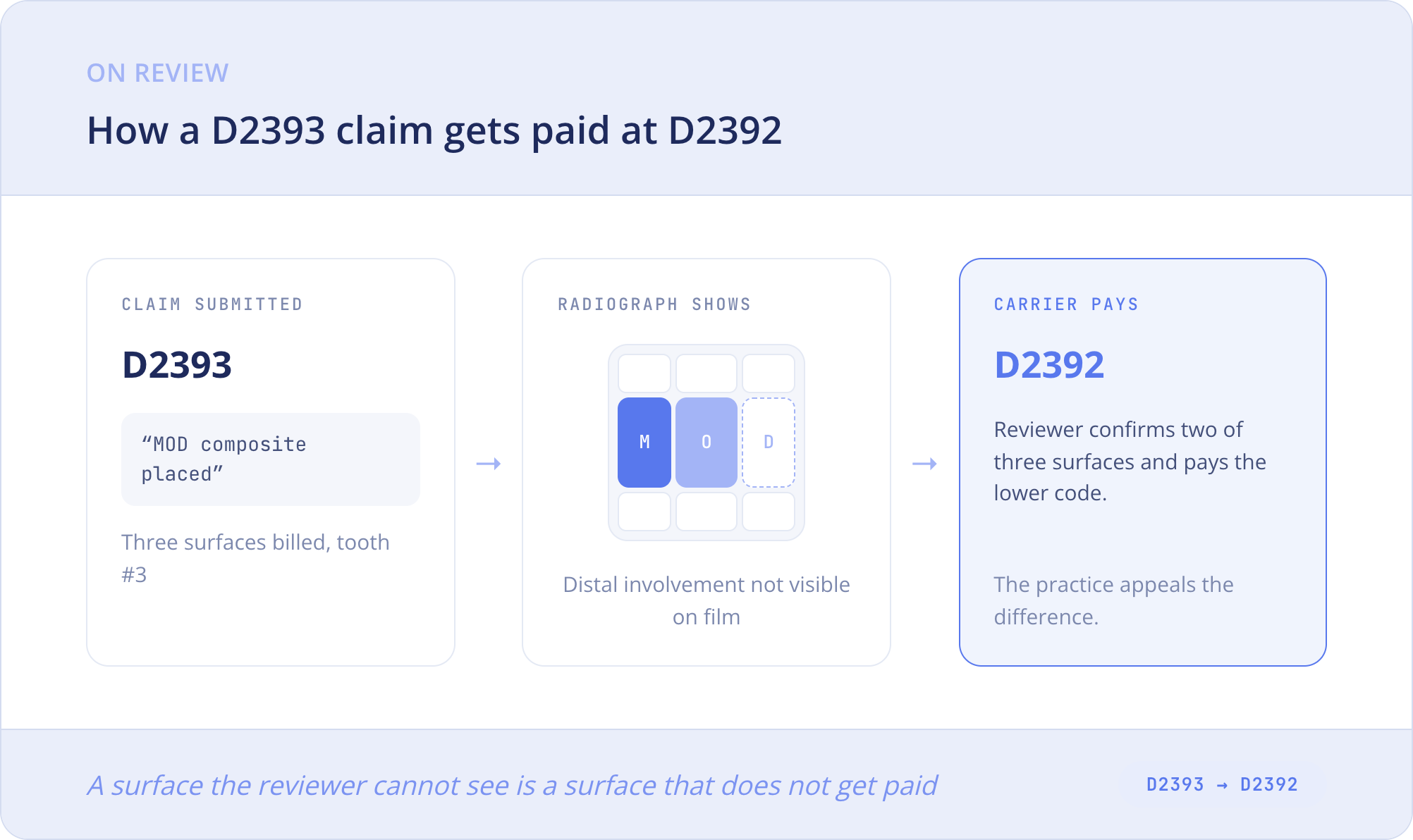
D2393 is frequently downcoded to D2392 on review. That usually happens when the note says something like "MOD composite placed" and the radiograph does not clearly show interproximal involvement on both the mesial and the distal. If a reviewer can confirm only two of the three surfaces, the carrier will often pay at D2392 and leave the practice to appeal the difference.
What is D2394?
D2394 covers a resin-based composite restoration on four or more surfaces of a posterior tooth, for example mesial-occlusal-distal-buccal (MODB) or mesial-occlusal-distal-lingual (MODL).
A claim supports D2394 when:
- Four or more surfaces are involved, extending beyond the standard MOD pattern to include a buccal or lingual wall.
- The restoration is larger and more structurally involved, often approaching what some practices would consider for an onlay or crown.
- Documentation names every surface, since this is the highest-paying code in the family and draws the most scrutiny.
Because D2394 sits at the top of the fee schedule for this family, it is also the code most likely to trigger a request for additional documentation or a narrative. A claim that simply says "four-surface composite," with no surfaces named and no imaging that supports the full extent of the restoration, is a common target for review.
Why surface counting decides the code in dental billing
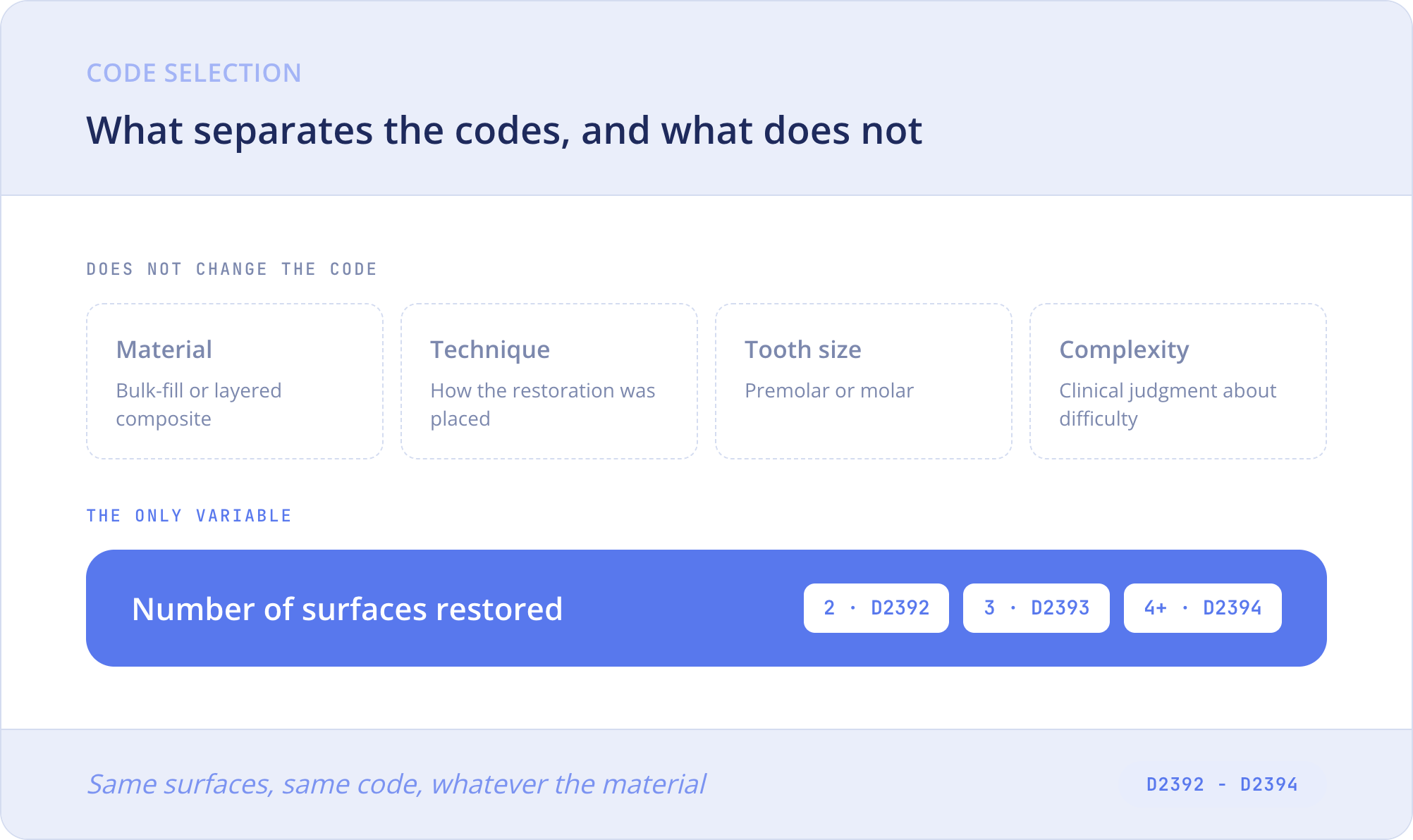
Technique, material, and tooth size do not separate these codes. A bulk-fill composite and a layered composite on the same surfaces bill under the same code, and clinical judgment about complexity plays no part in code selection. The number of surfaces restored is the only variable, which makes surface counting and the documentation behind it the deciding factor on every D2392, D2393, or D2394 claim.
How to improve claim acceptance for posterior composite codes D2392 through D2394
Three habits prevent most of the downcodes and denials in this code family.
- Name the surfaces, every time. A note that reads "MOD composite" supports the code, while "large filling" or "multi-surface restoration" gives a reviewer nothing to count. The claim and the chart note should use the same surface abbreviations.
- Match the code to the radiograph. If the claim lists three or four surfaces, the pre-op bitewing or periapical should show decay or breakdown extending into each surface claimed. A carrier that cannot visually confirm a surface on film will frequently downcode rather than deny the claim outright.
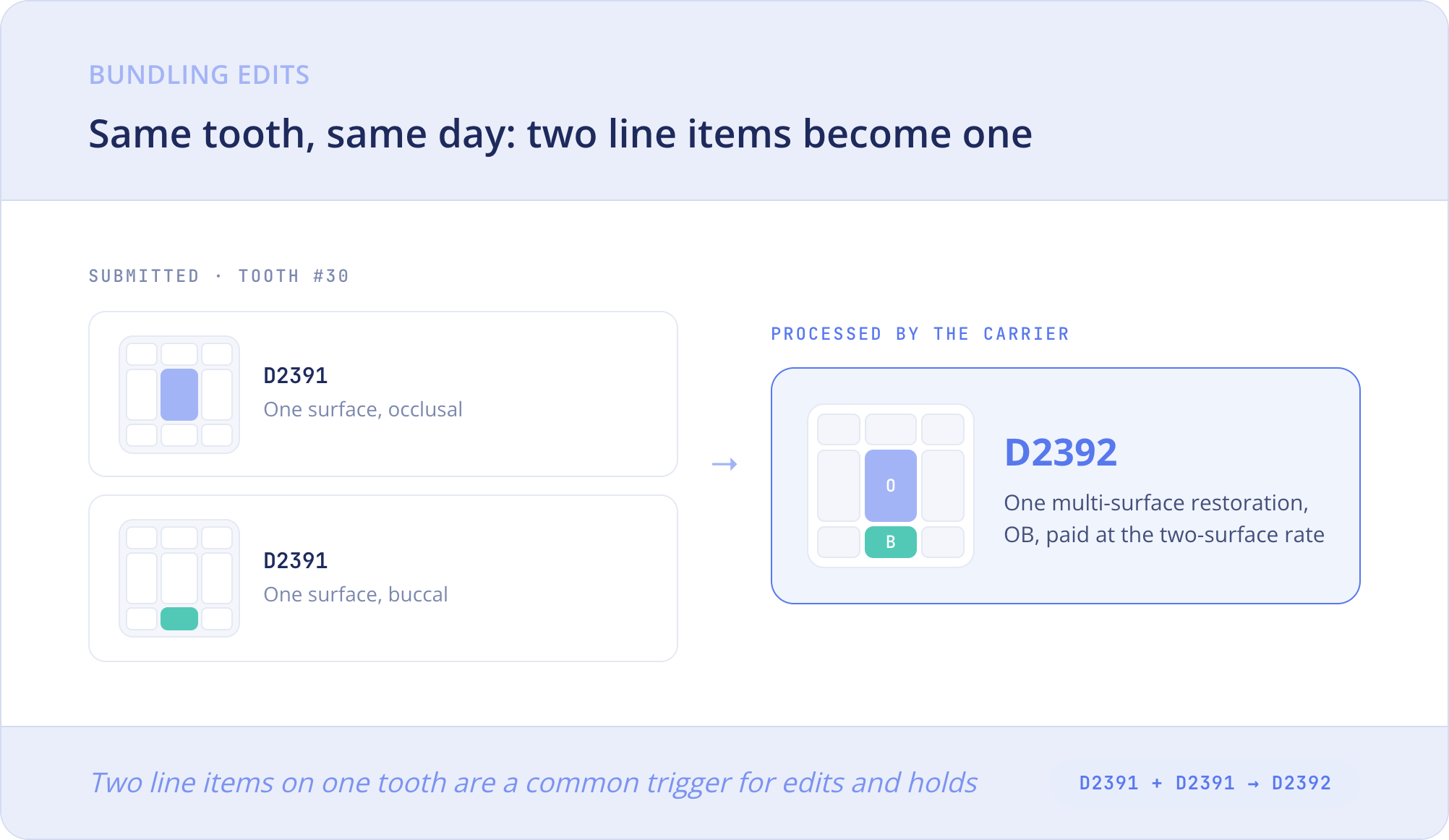
- Watch same-tooth, same-day claims. When two separate one-surface restorations are placed on the same tooth on the same date, many carriers apply bundling edits and process them as a single multi-surface restoration reflecting the total surfaces involved. Two separate line items on the same tooth are a common trigger for those edits and for claim holds.
Final Thoughts
D2392, D2393, and D2394 describe the same procedure at three different sizes, and the number of surfaces restored is the only variable that separates them: two for D2392, three for D2393, and four or more for D2394. When the operative note and the radiograph both name and support every surface on the claim, these are some of the most straightforward claims in restorative dental billing to get paid correctly on the first submission.
If your practice wants support with dental insurance billing, Dentalogic can help ensure claims are coded accurately and followed through to payment.
Note: This information is current as of September 2026. CDT guidelines and carrier policies may change, so always refer to the latest ADA Current Dental Terminology manual and carrier-specific requirements. This article is for informational purposes only and does not constitute professional billing or clinical advice. Consult a dental billing specialist for specific cases.
.png)