How to Read a Dental EOB: What It's Actually Telling You
An EOB lands in the batch, someone's eye goes straight to the patient-responsibility line, and it gets filed. That habit is invisible right up until it costs money. The EOB is the only place where the story is told line by line, in a format the payer built for the payer's own system.
Reading it well is part of protecting revenue, because the EOB is where a dental practice can tell a claim that genuinely isn't covered apart from one that was priced wrong.
The Five Numbers That Matter
Every EOB, regardless of carrier, answers the same five questions:
- Billed amount: the practice's own fee. It's easy to skim past, but payers pay on the lesser of the billed amount and the contracted fee, so a billed amount that matches the allowed amount to the penny can mean the practice's fee sits below what the plan would have paid.
- Allowed amount: what the payer recognizes for the procedure under this plan. This is the number worth stopping on.
- Write-off: on most lines, billed minus allowed, coded CO on the remittance. For in-network claims, this is the network adjustment the practice agreed to and generally can't bill the patient for. The Delta example below is the exception worth knowing.
- Plan paid: the payer's share of the allowed amount, after deductible and coinsurance.
- Patient responsibility: coded PR, and made up of deductible, coinsurance, copay, and any non-covered amounts left standing.
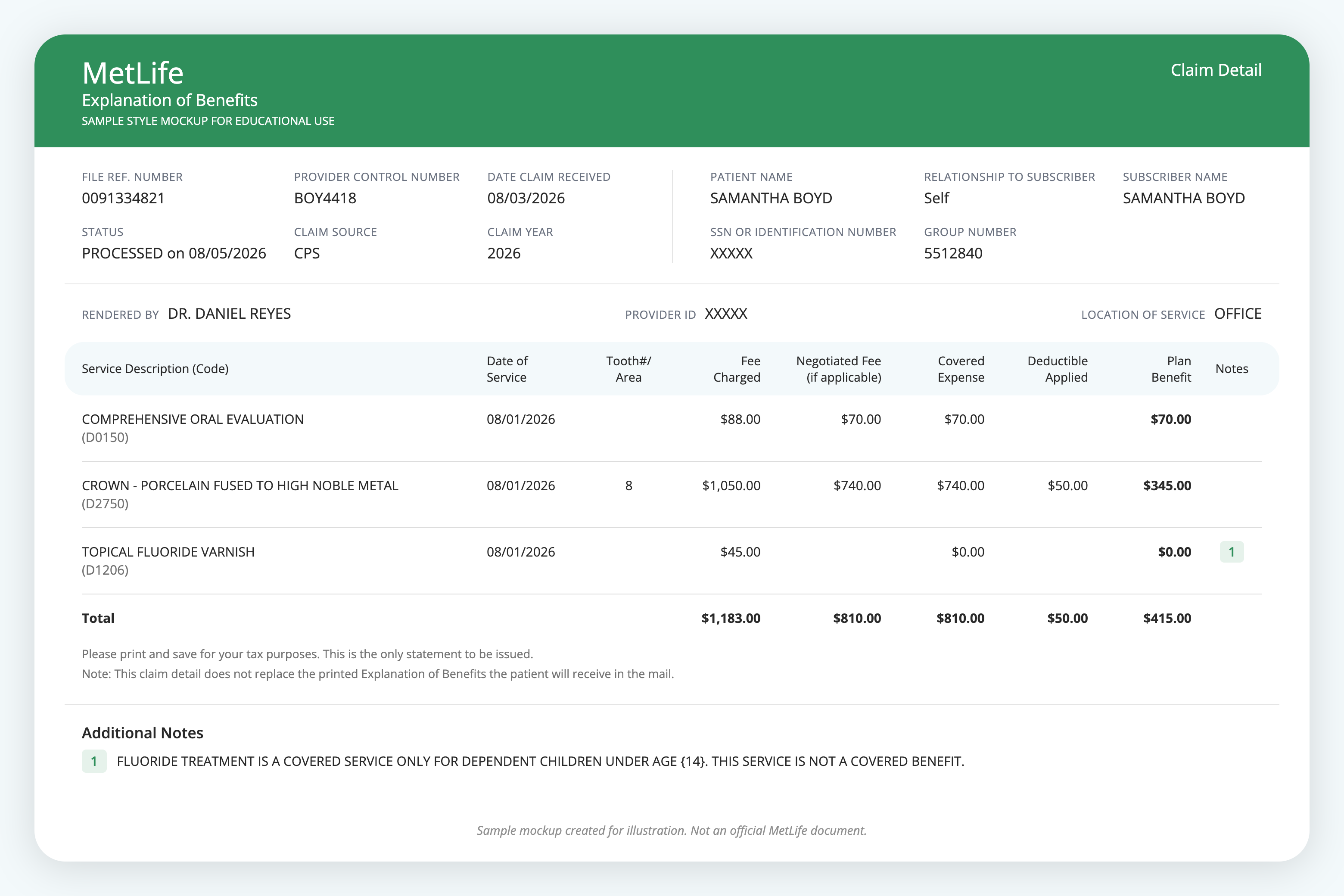
Look at the fluoride varnish line. MetLife shows $0.00 in covered expense, which is its term for the allowed amount, and leaves the negotiated fee blank. A note explains that fluoride is only covered for dependent children under 14. That makes it a non-covered service, which is a different situation from a network discount, and it changes what the practice can collect. Many states have non-covered services laws that let a participating dentist charge the full fee for a service the plan doesn't cover, which is how the whole $45 ends up with the patient here. Where no such law applies, the negotiated fee can still cap that charge, so it's worth knowing which rule you're under before that balance goes on the patient's statement.
Why the Allowed Amount Is the Real Signal
The allowed amount reflects whether the payer used the correct fee schedule and network status for that provider on that date of service, and reading it against the billed amount is where most pricing problems show up. Payers pay on the lesser of the practice's billed fee and the contracted fee. When a practice's fee for a code sits below the PPO schedule, the allowed amount simply matches the billed amount. The claim pays cleanly and nothing on the EOB flags that the practice left money on the table, which is why an in-network line where billed and allowed are identical deserves a second look.
An allowed amount that looks low on a claim the practice believes is in-network is often a sign that something upstream was processed incorrectly. The payer may have used the wrong fee schedule, applied a downgrade without the alternate-benefit rule being met, or relied on a network status its system hadn't updated. Every one of those is fixable, but only if it's caught before the claim is posted as paid in full and closed.
Downgrades are one of the most common ways the allowed amount moves without anyone flagging it. Here's a Delta Dental EOB where a porcelain crown on a molar was downgraded to the plan's alternate benefit, which pulled the allowed amount down and pushed the difference onto the patient:
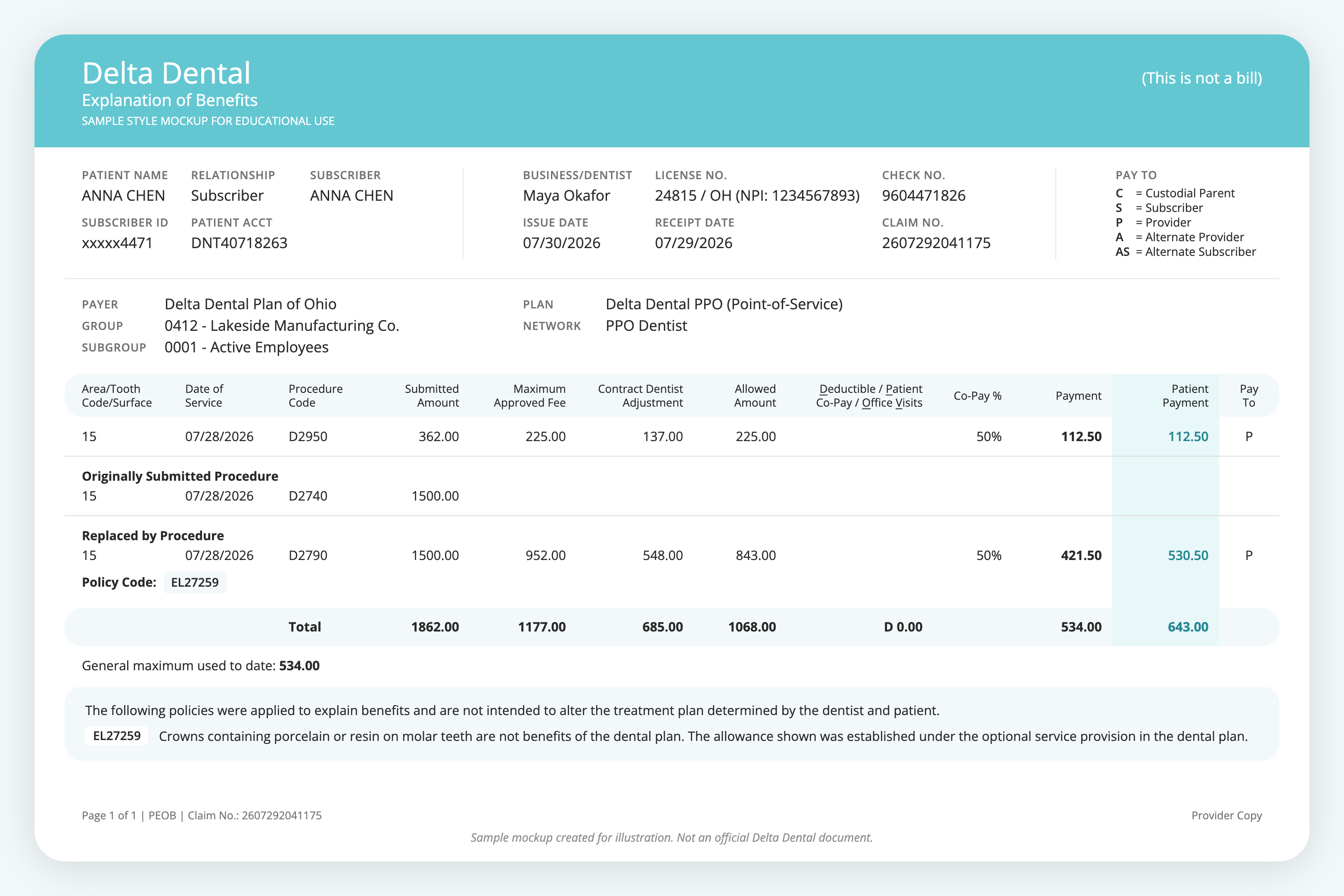
At a glance, the $548 contract dentist adjustment on the crown looks like any other network write-off, and it is one. The downgrade is spelled out right above it, where Delta lists the D2740 as originally submitted and replaced by D2790. It shows up again two columns over, where the $843 allowed amount sits below the $952 maximum approved fee. On the buildup line, those two numbers match at $225, which is what a normal line looks like. Delta paid its 50% on the alternate benefit, and the $109 gap between the crown's two fees moved into the patient's portion. That's why the patient owes $530.50 on a line where their share of the allowance comes to $421.50, and it's the number that needs explaining when the patient asks why their portion came in higher than the estimate they were given.
Remark Codes: Reading the Shorthand
Every adjustment on an EOB traces back to the electronic remittance behind it, the 835, where three kinds of codes do the explaining. A group code assigns responsibility, with CO marking a contractual adjustment the practice absorbs and PR marking the patient's share. A Claim Adjustment Reason Code (CARC) names the category of the adjustment, and a Remittance Advice Remark Code (RARC) adds the specifics.
A few come up on almost every dental claim: charges that exceed the fee schedule, a deductible or coinsurance amount, or a frequency limit that's already been used. Many printed EOBs don't show those codes directly and use the carrier's own shorthand instead. Delta prints policy codes like EL27259 under the line they apply to, while Cigna tags the line with a two-letter note and explains it at the end of the EOB.
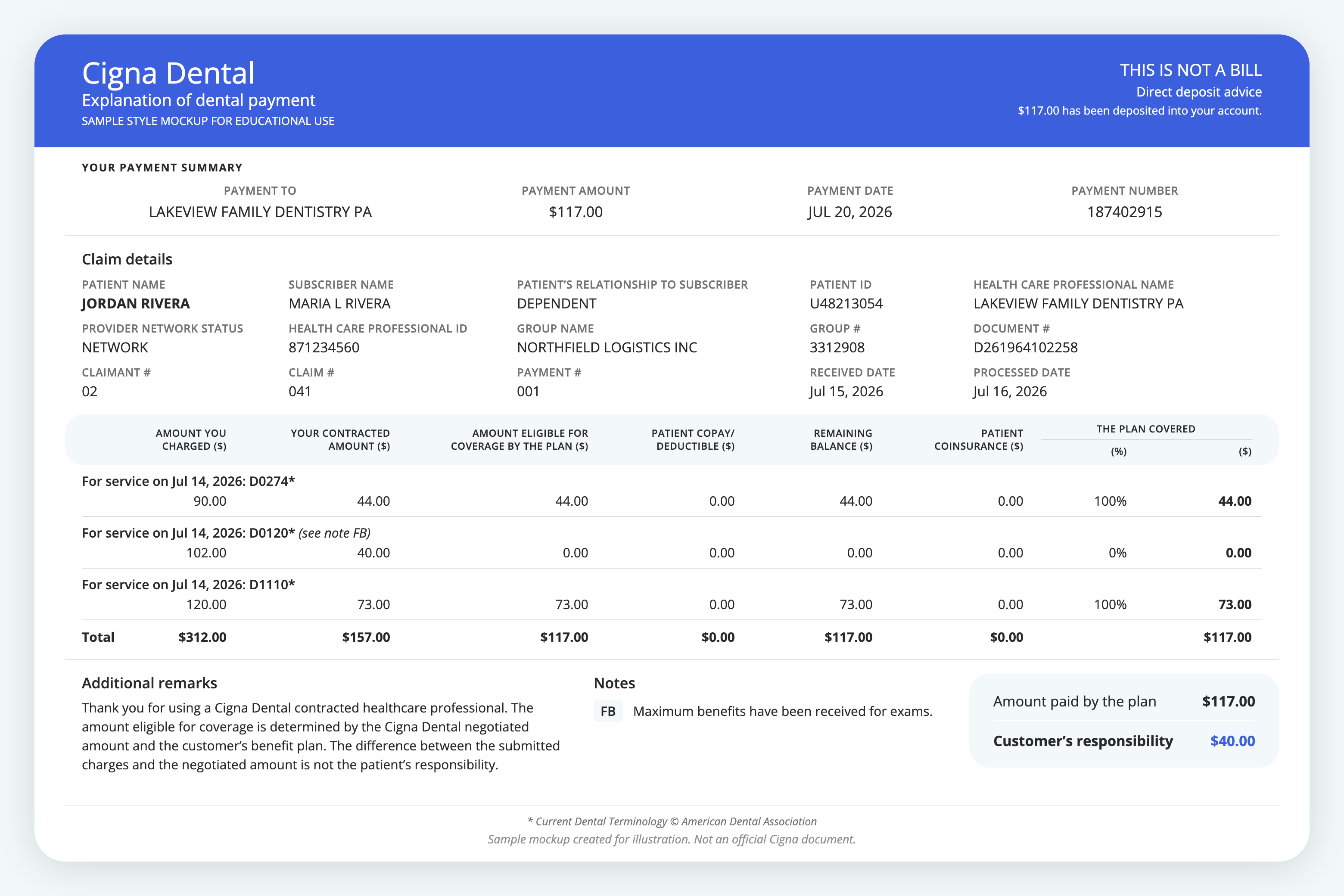
The D0120 line is the one worth slowing down on. Cigna recognized a $40 contracted amount for the exam and then made none of it eligible for coverage, so every column after that reads zero and the line looks like nothing happened. The reason sits in the note tag next to the code, which points to FB at the bottom of the EOB: the patient has already received the maximum benefit for exams. That $40 never appears on the line itself. It shows up in the customer's responsibility total on a claim where every patient column adds to $0, and without reading the note, nobody posting the payment would know why the patient owes anything at all.
Why Every Carrier's EOB Looks Different, and Why It Doesn't Matter
The three samples in this piece label the same information in three different ways, which goes a long way toward explaining why so many billing teams treat each payer as its own puzzle to re-solve.
Take the number this article keeps coming back to. Delta labels it the allowed amount and prints a maximum approved fee right beside it. On the Cigna page it becomes the amount eligible for coverage by the plan, and MetLife shortens it to covered expense. The write-off moves around too. Delta prints it as a contract dentist adjustment, while Cigna and MetLife leave you to subtract the contracted or negotiated fee from the charge yourself.
Underneath the layouts, the 835 behind each of those pages is built on the same group code, CARC, and RARC structure. Once that structure is visible, the layout stops being the obstacle.
Final Thoughts
Every EOB carries the answers to the questions a practice should be asking about each claim. Find the billed, allowed, write-off, paid, and patient-responsibility figures on every one, and read the remark codes before anything gets posted. Once that's a habit, underpayments and fixable denials tend to get caught while there's still time to appeal or correct them. Without it, a practice may not find out for months, if at all.
If your practice is sitting on a stack of EOBs from a dozen different carriers and wants a second set of eyes on what's being paid and why, Dentalogic can turn that pile into a system. Start at dentalogic.com or call 469-256-7114.
Note: This information is current as of October 2026. EOB formats, remark code sets, and adjudication rules vary by carrier and plan, and change over time. Non-covered services rules also vary by state. The carrier names referenced in this article are used solely to illustrate common EOB formatting differences. The sample documents shown are original mockups created for this article with fictional patient, provider, and claim details, and are not official statements from Cigna, Delta Dental, or MetLife. This article is for informational purposes only and does not constitute professional billing, clinical, or legal advice. Consult a dental billing specialist for specific cases.

.png)