

The Most Common CDT Coding Mistakes
CDT codes exist to give every carrier the same language for the same procedure. When that language is misapplied, the result is a denied claim, a downcoded reimbursement, or a compliance flag that can follow a practice into an audit. Most coding mistakes are not the product of carelessness — they come from documentation habits that have not kept pace and claims submitted faster than they are double-checked.
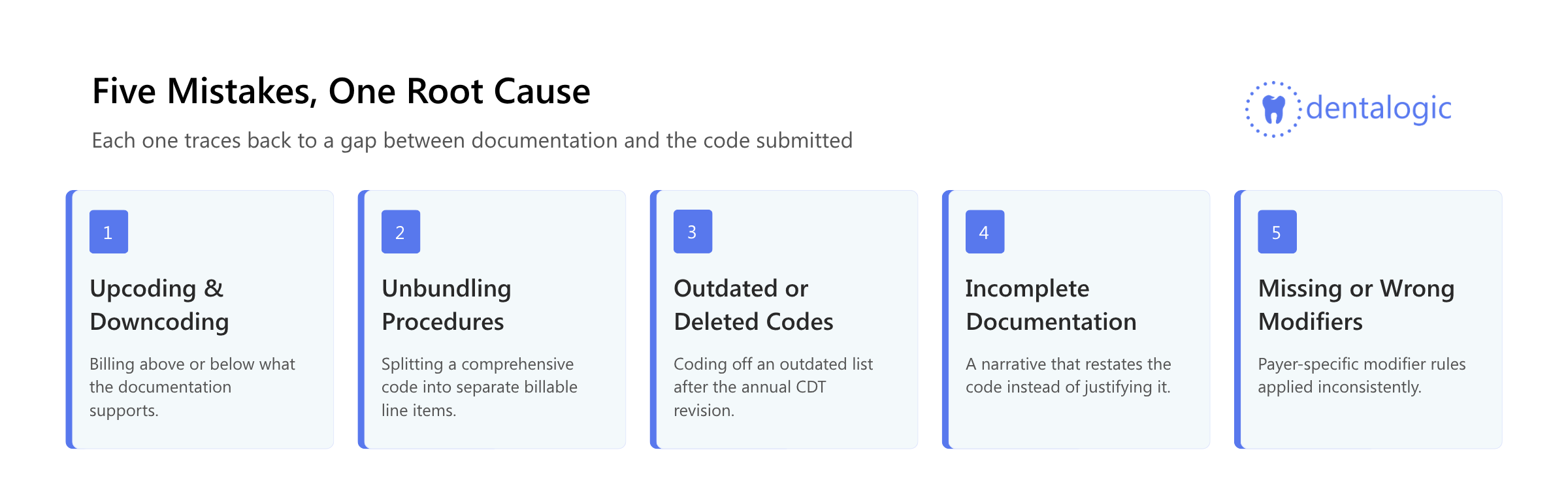
Upcoding and Downcoding
Upcoding occurs when a claim is billed at a higher level of service than what was actually performed — for example, billing a periodontal maintenance code for what was really a routine cleaning on a patient with no history of periodontal treatment. Downcoding is the opposite: billing a lower-paying code instead of the one that accurately reflects the procedure.
Both mistakes typically trace back to the same root cause: a billing team defaulting to the code they know best rather than the one the clinical documentation supports. If the diagnosis and treatment history do not support the code on the claim, the claim should not go out as written.

Unbundling Procedures
Unbundling occurs when a practice bills separately for services that a single comprehensive code already accounts for. Common examples include:
- Billing suture removal as a separate line item after an extraction
- Splitting one procedure into multiple line items that the payer expects to see billed as one
Payers maintain specific bundling rules, and most are applied automatically by the payer's claims engine. That means an unbundled claim does not just get denied — it can invite closer scrutiny of future claims from the same practice. The CDT manual and individual payer policies both spell out which procedures are considered inclusive of others. When in doubt, that is the reference to check before submitting, not after a denial comes back.
Using Outdated or Deleted Codes
CDT codes are revised annually. Codes are added, and codes are deleted outright. A practice still coding from last year's list will eventually submit a code that no longer exists or no longer means what it used to. The claim is rejected, and the delay in resubmission adds directly to aging accounts receivable.
Whoever manages codes on the team needs a defined process for updating references at the start of each year — not when someone notices a claim bouncing. A quick annual review against the current CDT manual catches this before it becomes a pattern.
Incomplete or Vague Documentation
A code can be entirely correct and still be denied if the documentation does not support it. Carriers reimburse based on whether the clinical notes justify the code, and payers increasingly expect a narrative that ties the diagnosis to the procedure with enough detail to stand on its own, including:
- Tooth number
- Quadrant
- Clinical findings
- Rationale for treatment
This is the easiest mistake to prevent and the most common to see, because it happens at the point of care rather than the point of billing. A narrative that simply restates the code back to the payer does not hold up. One that documents what was found and why the procedure was necessary almost always does.
Missing or Incorrect Modifiers
Modifiers tell a payer something the base code cannot, such as a tooth number or quadrant. A missing or incorrect modifier can hold up an otherwise correctly coded claim. Modifier requirements also vary by payer — what one carrier requires, another may not recognize at all — which makes this one of the more inconsistent problem areas to manage.
Final Thoughts
Most coding mistakes come down to the gap between what the chart note says and what the claim submits, and that gap widens the faster a practice is moving. Closing it is a matter of habit:
- Check documentation against the code – Before a claim goes out, confirm the notes support what is being billed.
- Keep bundling and modifier rules current – Payer requirements differ and change; verify rather than assume.
- Refresh the CDT reference annually – Update code lists at the start of each year, not after a rejection.
If your practice is looking for support with dental insurance billing, Dentalogic can help ensure claims go out correctly coded the first time and are followed through to payment.
Note: This information is current as of August 2026. CDT guidelines and carrier policies change, and coding should always be verified against the latest ADA Current Dental Terminology manual and payer-specific requirements. This article is for informational purposes only and does not constitute professional billing or clinical advice. Consult a dental billing specialist for specific cases.


.png)


