A crown is the one procedure where five documents have to agree: the lab slip, the claim, the plan document, the treatment estimate, and the patient's memory of what they were told. When they disagree, the patient learns about it from an EOB showing a balance several hundred dollars higher than the estimate, because the plan paid for a different crown than the one that was placed. That is the downgrade problem, and it starts with three codes that look interchangeable on a treatment plan: D2740, D2750, and D2790.
What Are D2740, D2750, and D2790?
Each code describes a different crown material.
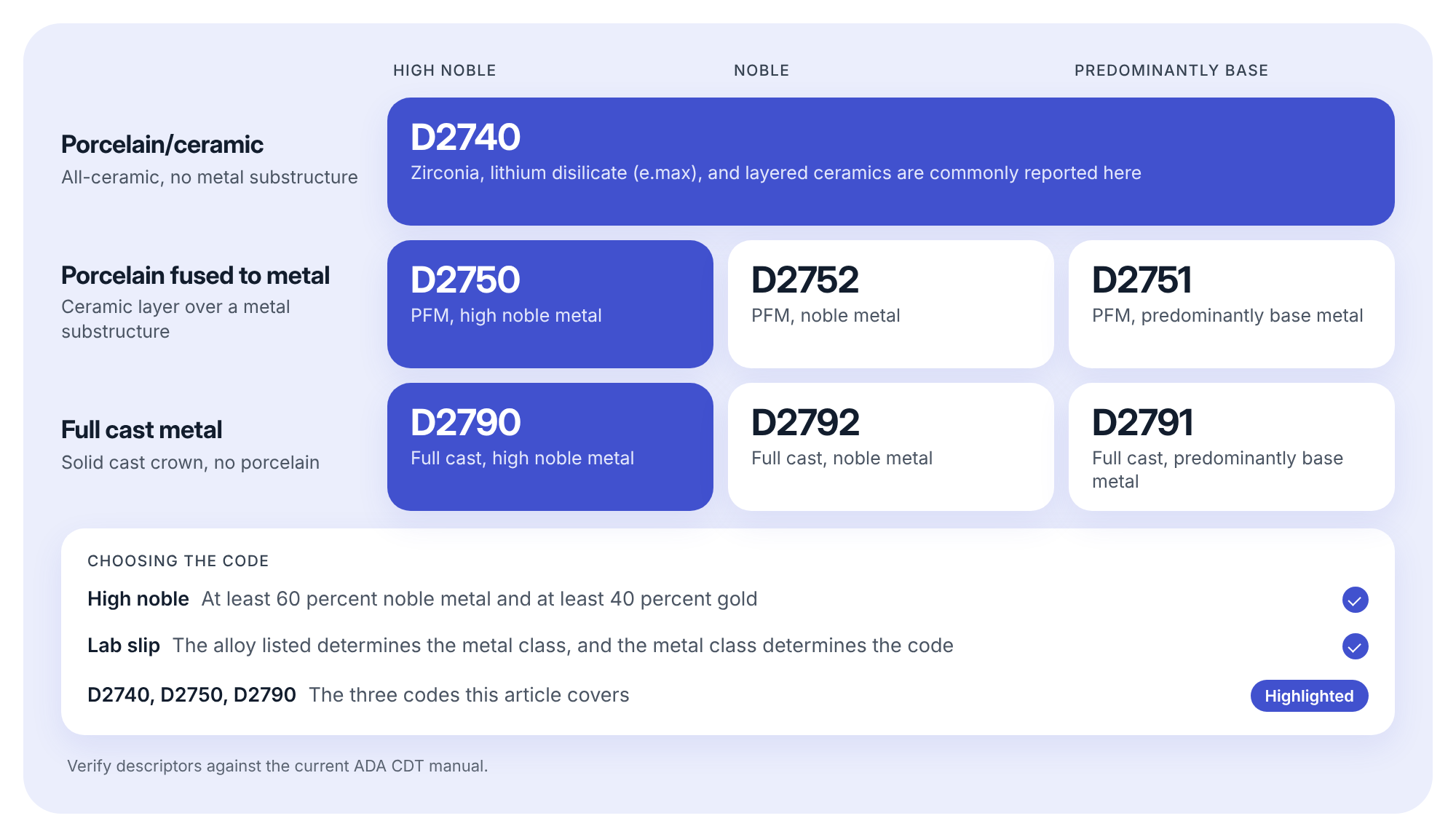
- D2740, crown, porcelain/ceramic: An all-ceramic crown with no metal substructure. Full-contour zirconia, lithium disilicate (e.max), and layered ceramics are commonly reported here. Older fee schedules still show the longer descriptor, "porcelain/ceramic substrate."
- D2750, crown, porcelain fused to high noble metal: A ceramic layer over a high noble metal substructure. Under CDT's alloy definitions, high noble means an alloy that is at least 60 percent noble metal and at least 40 percent gold.
- D2790, crown, full cast high noble metal: A solid cast crown in a high noble alloy, with no porcelain.
These three belong to a larger family. Porcelain-fused and full cast crowns both split again by alloy class (high noble, noble, and predominantly base metal), which is why D2751, D2752, D2791, and D2792 exist. The alloy class is where many downgrades land, and it is also the first place coding errors appear.
The Code Follows the Lab Slip
A porcelain-fused-to-metal (PFM) crown and an all-ceramic crown can look identical in the mouth. The difference is in the lab fabrication, so the correct code comes from the lab slip and invoice rather than from the chair or a photo. Practices tend to get into trouble in three ways:
- Defaulting to D2750 for every PFM: If the alloy is not high noble, D2750 is the wrong code. The alloy listed on the lab slip determines the metal class, and the metal class determines the code.
- Coding to what the plan covers: Billing a covered metal crown code when a ceramic crown was delivered, in order to avoid a downgrade, misrepresents the service. That is a compliance problem. The right approach is accurate coding paired with an accurate estimate and informed consent.
- Losing the lab slip: When a carrier reviews a crown claim, material confirmation from the lab slip or invoice sits alongside the pre-operative radiograph, and often intraoral photos, as supporting documentation. Attach these to the claim or retain them with it.
What Is a Downgrade?
"Downgrade" is the common term for an alternate benefit provision, also called a least expensive alternative treatment (LEAT) clause. Three points are worth keeping straight:
- A downgrade is different from a denial: The plan still pays toward the procedure, but at the rate of a less expensive alternative.
- It is a plan term: The clause is written into the plan, so it is not a processing error and appeals have limited success. What a practice can control is the accuracy of the estimate and a documented conversation with the patient before treatment.
- The benchmark is plan specific: A common pattern is a plan that pays posterior crowns at the metal crown rate while paying tooth-colored material in full on a visible front tooth. The benchmark code varies, though. It might be a full cast base metal crown, a noble metal crown, or a PFM, so do not assume it is D2790.
Why the Estimate and the EOB Don't Match
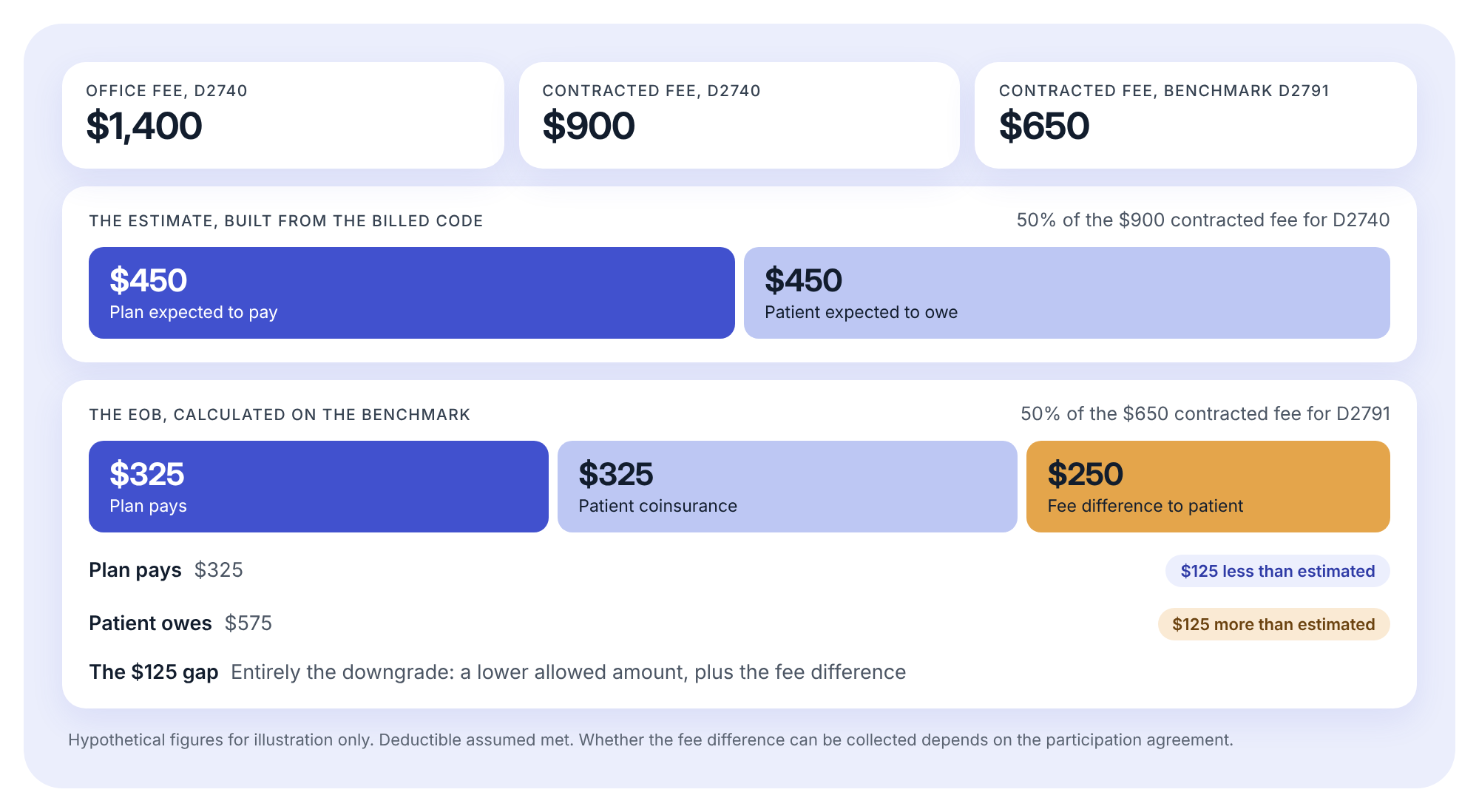
Consider an illustrative example with hypothetical numbers. The deductible has been met, the plan pays 50 percent for major services, and an alternate benefit provision benchmarks posterior crowns to a full cast base metal crown (D2791).
- Office fee for D2740: $1,400
- In-network contracted fee for D2740: $900
- In-network contracted fee for D2791: $650
Most offices build the estimate from the billed code. Fifty percent of the $900 contracted fee means the plan is expected to pay $450 and the patient is expected to owe $450.
The EOB shows something else. The plan calculates its payment on the benchmark, so it pays 50 percent of $650, which is $325. The patient owes $325 in coinsurance plus the $250 gap between the two contracted fees, for a total of $575. The $500 difference between the office fee and the contracted fee is the ordinary network write-off.
The estimate was off by $125, and that gap is entirely the downgrade. Two things moved at once: the percentage was applied to a lower allowed amount, and the patient picked up the fee difference. Neither is visible when the estimate is built from the billed code.
One caution on the patient's share. Whether a network provider can collect the full fee difference on a downgraded service depends on the participation agreement. Some contracts allow it and others limit what the practice may bill, so read the agreement before building patient estimates around it.
The sample Delta Dental EOB in our earlier article, How to Read a Dental EOB, carried a downgrade remark for this reason. The allowed amount and the plan payment were calculated on the alternate benefit, and the remark is the only place on the EOB where that fact is recorded.
Final Thoughts
D2740, D2750, and D2790 describe three different materials, and a plan may or may not treat them as equivalent. Code the crown that was placed, using the lab slip. Find out what the plan's benchmark is before the prep appointment, and build the estimate from that benchmark instead of the billed code. Practices that do these three things can show a downgrade as a line on the estimate, which means the patient hears about it before treatment and not from the EOB.
If your team spends its time explaining crown EOBs after the fact, Dentalogic can help with the verification and plan-build work that makes the estimate right the first time.
Note: This information is current as of November 2026. CDT code descriptors are revised annually, and alternate benefit provisions, frequency limits, waiting periods, and network contract terms vary by carrier and plan, so consult the latest ADA Current Dental Terminology manual and payer-specific requirements. The dollar amounts in this article are hypothetical and used for illustration only. This article is for informational purposes only and does not constitute professional billing, clinical, or legal advice.